
Can I Drive My Car If One Headlight Is Out?

It’s 6:00 PM, the winter sun has already dipped below the horizon, and you’ve just noticed something: your left headlight is completely dead. You’re only 10 minutes from home, and you are tempted to just risk it. Can you? Is it legal to drive with just one working headlight in Australia, and is it a safety issue?
This is one of those frustratingly common car troubles that every Aussie driver faces. It’s not just a minor annoyance; it’s a critical component of your car’s safety and legal compliance. While you might technically be able to see enough with the remaining beam, driving with a single headlight out is not only unsafe but also risks a defect notice and a significant fine.
The Core Question: Legal vs. Illegal in Australia
Let’s get straight to the legal point. Across Australia, traffic regulations and vehicle standards are consistent: it is illegal to operate your vehicle at night (or during periods of reduced visibility) if any of your required lights are not functioning correctly.
Each state, from New South Wales (Transport for NSW) to Queensland (TMR), and Victoria (VicRoads), interprets this.
Is it a simple fix? Yes. Is it a minor offense? No. When one headlight goes, your car is no longer compliant.
What’s the Legal Catch?
A police officer who pulls you over with a blown headlight can issue you a defect notice. This notice effectively states that your vehicle is unroadworthy and cannot be legally driven until the issue is repaired and the defect is cleared.
You aren’t just looking at a "fix-it" ticket; you are potentially dealing with:
A fine that can exceed $150 (depending on your state).
Loss of demerit points (yes, really, in some jurisdictions).
The inconvenience of having to clear the defect.
Bottom line: The second you realize one headlight is out, your priority must shift to getting it fixed. Driving "just home" could cost you hundreds.

The Safety Reality: Why It Actually Matters
It’s easy to focus solely on avoiding a fine, but the real issue is your own safety and the safety of everyone sharing the road with you. Headlight function is not just about illuminating the path in front of your car; it’s about signaling your presence and intentions.
Reduced Visibility (For You)
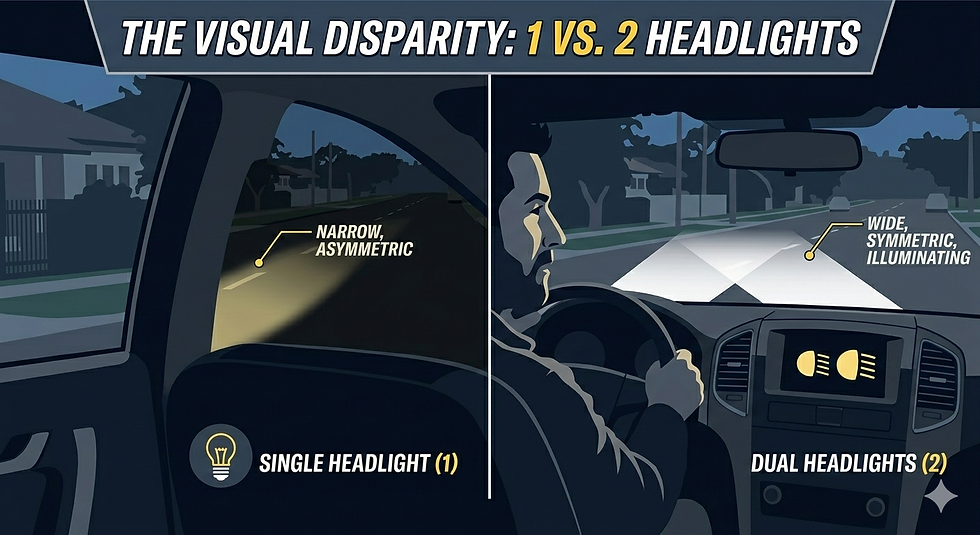
The most obvious problem is that your visual field is cut in half. With only one headlight, your depth perception is severely compromised, especially on rural Australian roads where unlit obstacles are common.
Think about those dusk-to-dawn conditions when you have to spot:
Kangaroos (or other wildlife) that can dart into your path.
Potholes or debris.
Pedestrians or cyclists.
A blown headlight doesn't just dim the road; it blinds a critical angle of your vision.
Being Seen (By Others)

This is perhaps the more dangerous aspect. When another vehicle sees your single headlight, they don’t see a car; they see something that looks like a motorcycle. This is a massive perception error.
An oncoming driver might try to pass you, misinterpreting your position and speed, leading to a catastrophic head-on collision. By driving with a single headlight, you are effectively a moving hazard that is mislabeled.
Halogen, HID, and LED: Knowing Your Headlight Type

Not all headlights are created equal, and the type of bulb you have drastically changes both the cost and the replacement time. Knowing what you have is your first step.
1. Halogen Headlights (The Classic)
These are still the most common bulbs, especially on older Australian vehicles.
How They Work: A tungsten filament inside a quartz capsule gets superheated.
The Problem: They are hot, inefficient, and the filament eventually burns out.
Cost: The cheapest to replace, typically between $20 and $50 for a single bulb (DIY).
Time to Replace: Often a 15–30 minute job if you have clear access.
2. HID/Xenon Headlights (The "Blue-ish" Hues)
This type became popular on high-end vehicles in the 2000s and 2010s.
How They Work: They don't use a filament; instead, they use a high-voltage electrical arc through Xenon gas. They are the ones that look very white/blue when you first start your car and then stabilize.
The Problem: The bulbs and the ballasts (the electronic components that power them) are very complex.
Cost: High. A quality HID bulb can run $100–$250.
Time to Replace: Complex and often requires professional installation, taking 45 minutes to 1.5 hours.
3. LED Headlights (The Modern Standard)
This is the standard on almost all new Australian vehicles.
How They Work: An array of LEDs emits bright light instantly. They consume much less power than the other types.
The Problem: They are often integrated into complex, multi-component headlight assemblies (Housings). If an LED fails, you often can’t just swap a "bulb"; you have to replace the entire housing.
Cost: High. An assembly can range from $300 to over $1,000.
Time to Replace: Since you have to swap the housing, this can take 1 to 2 hours, and sometimes requires removing the bumper bar.
When a Failed Headlight Means You Need a Specialist
You might be tempted to just pop down to Supercheap Auto or Autobarn and grab a replacement bulb for your car. This is fine for some, but not for others.
You Should DIY If:
You are confident you have basic Halogen bulbs.
You have checked your owner’s manual and have a clear understanding of how to access and replace the bulb safely.
You Need to Call an Automotive Electrician/Specialist (Like ECA EUROCARE AUTO) If:
You have HID or LED headlights. The voltages involved are dangerous, and the assemblies are complex.
Your car is newer. Modern, sleek designs often have incredibly tight engine bays where a headlight unit replacement requires significant component removal.
You can't even see the bulb housing. (If it requires removing the bumper bar, that is a specialist job).
Driving Strategy: What to Do If Your Headlight Fails
So, your headlight is blown. What are your options for getting home, and how should you drive in that moment?
Don’t ignore it. The first step is acknowledging the issue.
Limit driving, but do not stop. You must drive as little as possible. Your only trip should be from where you noticed the failure directly to your mechanic, a well-lit parking area, or your home.
Avoid high-speed roads. Stick to urban, lower-speed, and well-lit roads where your presence is clearer.
Increase your following distance. Give yourself (and others) extra reaction time.
Do not use high beams. While this sounds intuitive, using your high beams can blind other drivers and make it harder for them to judge your distance. They also won't replace your low-beam coverage effectively.
Get it fixed immediately. This is your primary directive.
Frequently Asked Questions
Q1: Can I drive my car home from the shops if my headlight fails in the parking lot?
No. Legally, the car is unroadworthy for night use the second that light fails. You are taking a risk. If you are extremely close (under 2 km on well-lit streets), you might take the risk, but be aware you are open to a fine.
Q2: Will one blown headlight affect my insurance if I have an accident?
Potentially. While it won't automatically invalidate your policy, your insurer will assess if you are negligent. Driving with a known safety defect (like a single headlight) at night could be considered negligence, which can impact your claim, especially if the accident was related to visibility.
Q3: Can I get my headlight replaced at my regular mechanic, or do I need an auto electrician?
It depends. For simple Halogen bulb swaps, your regular mechanic can handle it. For complex HID or LED units and assemblies, a specialist automotive electrician (Auto Elec) is the far safer and often faster option.
In conclusion, driving with only one working headlight is a common, but serious issue for any Australian driver. You must prioritize your safety, legal compliance, and the predictability of your vehicle on the road. If you find yourself with one headlight out, consider it a clear sign: your only drive should be to get it replaced.


Comments