
What Is the First Sign of Transmission Failure?
Updated: May 7
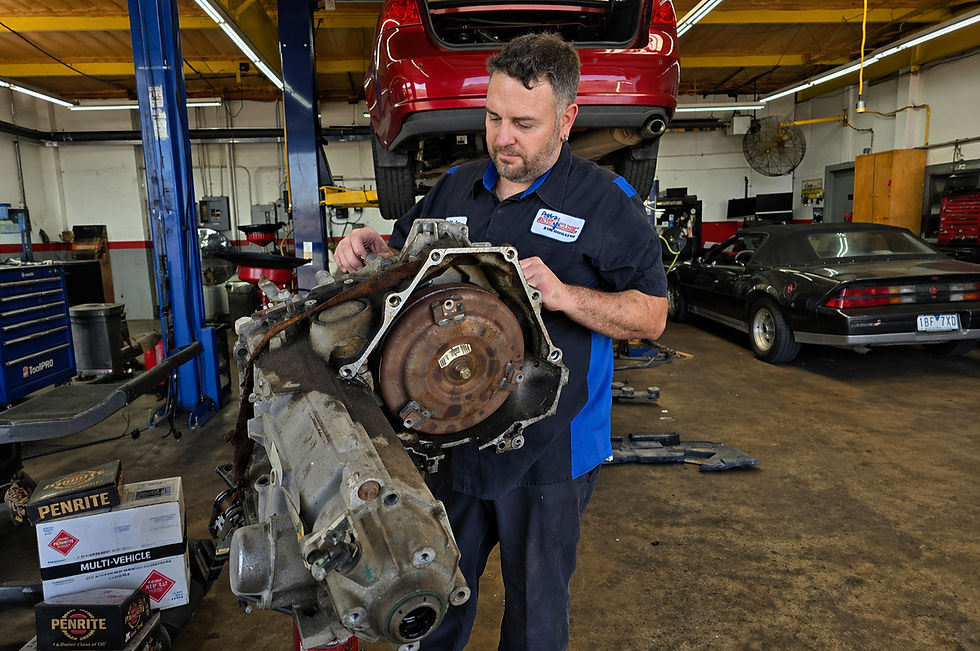
There is a particular kind of denial that happens with cars when it comes to the First Sign of Transmission Failure. You feel something slightly off, a tiny hesitation when you pull out of a parking spot, a very faint shudder when the car changes gear at highway speed, a smell that only lasts a few seconds and you're not quite sure what it was. And you tell yourself it's nothing. Maybe it's the cold morning. Maybe it was just that speed bump. You keep driving and it doesn't happen again for a week.
The problem with this pattern when it comes to gearbox health is that the First Sign of Transmission Failure is often genuinely subtle—subtle enough to be explained away, subtle enough to be forgotten. And then it comes back, slightly less subtle. And then less subtle again. By the time most Australian drivers end up at a transmission specialist, what started as a minor repair has often become a significant one, simply because the early signals were there and not acted on.
This guide is about recognising the First Sign of Transmission Failure, what it feels like, what it means, how urgent each one is, and what to do when you notice them.
First Sign of Transmission Failure: Delayed Engagement
If there is one sign that consistently appears first, before noise, before slipping, before warning lights, it is delayed engagement. This is the pause that happens after you shift from Park to Drive, or Park to Reverse, before the car actually starts to move.
In a healthy automatic gearbox, this transition should be nearly instant. You shift to Drive, there is a very slight bump as the gearbox engages, and the car moves. The whole thing takes less than a second and feels firm and definite.
Delayed engagement is when that transition takes noticeably longer, one second, two seconds, sometimes three or more. During that pause, the engine is running, you're in Drive, but the car isn't moving yet. The engine might rev slightly when you apply throttle before the car finally catches and moves.
What makes delayed engagement the earliest sign is that it often appears in specific conditions before it becomes constant. You might notice it only on cold mornings, when the transmission fluid is thicker and takes longer to build pressure. You might notice it only after the car has been sitting for several hours. Drivers often dismiss it as a cold-weather quirk and forget about it in summer, but when it returns the following winter it's slightly worse, and it's only a matter of time before it starts happening in warm weather too.
The cause of delayed engagement is almost always hydraulic pressure-related, the transmission is taking longer to build the fluid pressure needed to engage the clutch packs or bands that put the gearbox into gear. The most common reasons are low or degraded transmission fluid, a worn fluid pump, or early-stage clutch pack wear. All of these are far cheaper to address when caught at the delayed engagement stage than after they develop into the next stages.
Warning If You Notice Delayed Engagement, Act Now Delayed engagement is the canary in the coal mine. It will not fix itself. It will worsen over time. The cost of a fluid service that might resolve the issue at this stage is $150-$350. The cost of a full transmission rebuild if you continue to drive through the worsening stages is $3,000-$8,000. Book a workshop visit within the week, not the month. |
All the Warning Signs, What to Look and Listen For
Delayed engagement is the first sign, but gearbox problems communicate in multiple ways. Here is the complete reference table of warning signs, what they feel like in practice, their most likely cause, and how urgently each needs attention:
Warning Sign | Type | What It Feels/Looks Like | Most Likely Cause | Urgency |
Delayed engagement | Gearbox | The car pauses 1-3+ seconds after shifting into Drive or Reverse before moving. The engine revs but the car stays still. | Fluid pressure problem, worn clutch packs, failing pump | High, worsens rapidly without attention |
Gear slipping | Gearbox | Engine RPM rises but the car doesn't accelerate proportionally. Feels like momentary power loss mid-drive. | Worn clutch packs, low fluid, failed solenoid | Critical, dangerous to drive |
Harsh or rough shifting | Gearbox | Gear changes feel jolting, clunky, or jerky instead of smooth. Car shunts forward or backward on each change. | Low/degraded fluid, worn bands, solenoid fault | High, component damage accelerates |
Red fluid under the car | External | A reddish or pinkish puddle where the car was parked. Darker red/brown if fluid is old and degraded. | Damaged seal, gasket, cooler line, or pan | High, fluid loss leads to rapid failure |
Burning smell | Sensory | A sharp, acrid smell, distinct from exhaust, noticeable during or after driving. Often stronger after sustained driving. | Overheating from low or degraded fluid | High, overheating causes accelerating damage |
Whining, humming or grinding | Auditory | Unusual sounds during gear changes or at specific speeds. Grinding is more serious than whining. | Low fluid, worn bearings, damaged gears | Moderate-High, worsens if ignored |
Check engine or warning light | Dashboard | Check engine light or dedicated gearbox/transmission warning light illuminated on the dash. | Sensor fault, solenoid issue, slipping detected by TCM | Moderate, requires OBD scan to diagnose |
Limp mode activation | Dashboard/Performance | Car locks into one low gear and won't shift normally. Speed limited to approximately 60-80 km/h. | TCM detected a fault severe enough to trigger protective mode | High, driving beyond this risks serious damage |
Dark or burnt-smelling fluid | DIY inspection | Fluid on dipstick appears dark brown or black instead of bright red/pink. Burnt smell when sniffed. | Fluid degradation from heat and age, internal contamination | Moderate, indicates service overdue or overheating |
Difficulty engaging gear | Manual specific | Gear lever resists going into gear, grinds when changing, or pops out of gear while driving. | Worn synchromesh, clutch wear, low gear oil | High for grinding, moderate for stiffness |
* Urgency ratings are general guides. Always have any new or unusual symptom assessed by a qualified mechanic or transmission specialist. Do not continue driving a vehicle showing Critical warning signs.
Understanding Each Warning Sign in Detail
Gear Slipping, The Most Dangerous Early Symptom
Gear slipping is where the gearbox fails to maintain a gear under load. The clearest way to recognise it: you're cruising at highway speed, you accelerate to overtake, and the engine revs climb sharply, but the car's speed doesn't increase proportionally. The engine sounds like it's working hard but the power isn't reaching the wheels. Or the gearbox momentarily 'drops out' of gear and then re-engages with a small jolt.
This is different from delayed engagement in that slipping happens while you're already moving, not just from a standing start. It is a more serious symptom because it can create genuinely dangerous situations, attempting to merge onto a freeway or overtake on a country road and having the power momentarily disappear is not a minor inconvenience. If you experience slipping, do not use the vehicle for highway driving until it has been assessed.
Slipping in an automatic is most commonly caused by worn or burnt clutch packs (the friction material that engages the gears), failed solenoids (electronically controlled valves that direct hydraulic pressure), or severely degraded transmission fluid that can no longer maintain adequate film strength to prevent clutch slip.
Harsh or Rough Shifting, Normal Changes Become Noticeable
A healthy automatic gearbox changes gears so smoothly you barely feel it. When shifting becomes harsh, jerky, or produces a noticeable thud on each gear change, something is wrong. You might feel the car momentarily shunt forward as it shifts from second to third gear. Or there's a brief, sharp vibration each time the gearbox changes down under braking.
Harsh shifting can have several causes: degraded fluid that has lost its viscosity modifiers (the additives that provide cushioning during gear changes), a worn valve body (the hydraulic control unit inside the gearbox), failing solenoids, or early wear in the clutch packs. It is worth noting that some vehicles, particularly older models, can develop harsh shifting that's resolvable with a fluid change alone. This is one reason why a fluid service is always the first step in diagnosing gearbox complaints.
Fluid Under the Car, Never Normal
Transmission fluid is a bright red or pinkish-red colour when new. As it ages and degrades, it darkens to a brownish-red, and when severely burnt it turns dark brown or almost black. Any pooling of reddish or brownish fluid under a parked car is a transmission concern, the gearbox is a sealed system that should never lose fluid through normal operation. If fluid is on the ground, it has escaped through a failed seal, gasket, cooler line, or a cracked pan.
The practical urgency depends on the rate of loss. A small drip, a few drops overnight, allows time to get to a workshop within a few days. A larger pool or visible staining along the underside of the car suggests a more significant leak that warrants same-day attention. Continuing to drive with a progressively leaking gearbox will eventually result in the fluid level dropping to the point where the pump starves, causing rapid and severe internal damage in a very short period.
The Burning Smell, A Sign of Overheating
Transmission fluid has a specific, sharp, acrid smell when it overheats, distinctly different from exhaust smell or burning rubber, and immediately recognisable once you've encountered it. The smell is most common after sustained hard driving, towing, or extended stop-start traffic in Australian summer conditions, where underbonnet temperatures already push lubricant performance.
The smell indicates the fluid is exceeding its thermal limits and beginning to break down. This is a serious problem because degraded fluid provides less lubrication and less hydraulic pressure, accelerating the very wear it's supposed to prevent. In Australian conditions, particularly in Queensland and the NT where summer temperatures and towing are frequent realities, overheating is one of the most common causes of premature gearbox failure in 4WDs and utes.
If you smell something burnt after a drive, check the fluid level and condition immediately. Dark, thin fluid with a burnt smell needs to be changed before further driving. If the fluid level is also low, top up with the correct fluid and drive gently to a workshop, do not continue towing or hard driving.
Warning Lights and Limp Mode
Modern vehicles have Transmission Control Modules (TCMs), computers that monitor gearbox behaviour in real time and detect problems often before the driver feels them. When the TCM detects something outside normal operating parameters, it triggers the check engine light or a dedicated transmission warning light (usually a gear symbol).
More significantly, when the TCM detects a serious fault, it may activate limp mode, a protective state where the gearbox locks into a single low gear (usually second or third) and the vehicle's speed is limited to around 60-80 km/h. This is not a malfunction; it is the car actively protecting the gearbox from catastrophic damage by reducing load. If your car suddenly feels sluggish, won't change gear, and seems stuck in one ratio, limp mode has activated.
Getting the fault codes read with an OBD II scanner (available at any mechanic workshop, and basic versions are available for under $50 at Repco or Supercheap) will reveal the specific TCM fault code, P0700 is a general transmission system malfunction, while P0730-series codes indicate gear ratio errors (slipping detected electronically). These codes pinpoint the problem and prevent unnecessary parts replacement by identifying which component or circuit has failed.
How Urgency Differs, What You Can Drive On and What You Can't
Not every gearbox symptom requires you to call a tow truck on the spot. Here is an honest guide to how urgently each situation needs attention:
Stop driving immediately: Gear slipping during highway driving or overtaking, limp mode activation, complete refusal to engage any gear, warning light combined with slipping or harsh shifting, burning smell combined with any other symptom. These situations risk causing severe and expensive additional damage with every kilometre driven.
Drive carefully to a workshop, today: Active fluid leak (pooling under car), burning smell after driving (check fluid first), warning or check engine light alone with no other symptoms, persistent harsh shifting that has recently developed.
Book a workshop visit this week: Delayed engagement on cold starts that consistently occurs, slight hesitation in gear changes that is new behaviour, fluid that checks as dark or burnt-smelling on the dipstick, whining sound that is new and appears consistently at certain speeds.
Schedule at next service: Fluid due for change per service schedule (most important maintenance item), minor stiffness in manual gear lever in cold weather that clears when warm, occasional very slight roughness that is inconsistent.
The Fluid Dipstick Check, Do This Monthly Most automatic gearboxes have a transmission fluid dipstick (some sealed modern units do not, check your manual). Pull it out when the engine is warm and running in Park. The fluid should be bright red or pinkish-red and should not smell burnt. A simple monthly check catches fluid degradation and level drops before they develop into symptoms. This two-minute habit can prevent a four-figure repair bill. |
What Causes a Gearbox to Fail in the First Place
Understanding the causes of gearbox failure helps you both prevent problems and understand what you're being told when a mechanic describes the fault:
Neglected fluid changes: This is the primary cause of preventable gearbox failure. Transmission fluid degrades over time, its viscosity modifiers break down, its friction modifiers wear out, and it accumulates combustion byproducts and metal particles. Old fluid provides less lubrication, less hydraulic pressure, and less cushioning during gear changes. The result is accelerated wear on clutch packs, bands, bearings, and the valve body. Most gearbox failures in Australian workshops trace back to extended fluid change intervals.
Overheating: Heat is the primary enemy of gearbox fluid and internal components. Sustained towing near or above rated capacity, stop-start urban driving in summer heat, and driving aggressively in low gears all generate heat that the transmission cooler must manage. When heat exceeds the cooler's capacity, fluid begins to degrade rapidly and internal components can warp, score, or seize. In Australian conditions, particularly for ute owners doing regular towing in Queensland or WA summers, transmission temperature management is critical.
Wrong fluid type: Different gearbox types require specific fluid formulations. Using standard ATF in a CVT that requires CVT-specific fluid, or using a generic fluid when a manufacturer-specific grade is required (such as ZF Lifeguard 8 for ZF 8-speed units) can cause rapid internal damage. The friction modifiers in transmission fluid are carefully calibrated for the specific clutch materials and solenoid characteristics of each gearbox type, using the wrong fluid is often worse than using overdue correct fluid.
Overloading and towing abuse: Every gearbox has a rated towing capacity. Exceeding it, even occasionally, generates heat and load spikes that accelerate wear on clutch packs and the torque converter. For DCT-equipped vehicles, prolonged clutch slippage while manoeuvring a heavy trailer at low speed is particularly destructive, as the clutches cannot fully dissipate the heat generated.
Deferred maintenance on related systems: A cooling system that isn't maintaining proper engine temperature, an engine that is burning oil (which can contaminate transmission fluid via certain vehicle architectures), or a drive shaft that has developed vibration can all affect gearbox operation and accelerate wear.
The Five Habits That Prevent Most Gearbox Failures
Change transmission fluid on schedule, every 40,000-60,000 km for most automatics. This one habit prevents the majority of gearbox failures
Always use the manufacturer-specified fluid type, wrong fluid causes damage; ask your mechanic to confirm the correct spec
Never tow beyond rated capacity, sustained overloading is one of the fastest ways to destroy a gearbox
Check fluid monthly on the dipstick, catch level drops and degradation before they create symptoms
Book for diagnosis at the first unusual symptom, delayed engagement today is a fluid service; delayed engagement ignored for six months is a rebuild
What Repairs Cost in Australia, A Realistic Guide
One of the most anxiety-inducing parts of any gearbox conversation is the cost. Here is an honest breakdown of what different levels of intervention typically cost across the Australian market in 2026:
Repair Type | Applies To | Cost (AUD) | Typical Timing | Notes |
Fluid change + filter | Any | $150-$350 | Every 40,000-60,000 km | Preventive maintenance, highest value service available |
Solenoid replacement | Auto | $300-$900 | When fault detected | Cheaper than rebuild; fixes shifting and engagement issues |
Clutch replacement | Manual | $800-$2,000 | 100,000-180,000 km depending on habits | Normal wear item, expected cost of manual ownership |
Torque converter replacement | Auto | $1,200-$2,500 | When shudder confirmed | Common repair, often combined with fluid service |
Transmission rebuild | Auto / Manual | $2,500-$6,000 | When internal wear confirmed | Restores function; cheaper than replacement on common vehicles |
Full replacement (reco unit) | Auto / CVT / DCT | $4,000-$12,000+ | When rebuild not viable | European/luxury vehicles at upper end; common Japanese lower |
CVT belt/unit replacement | CVT | $3,500-$8,000 | When belt or pulley fails | Often requires full unit replacement, cannot be economically rebuilt |
* All costs are in AUD as of April 2026. Prices vary by city, vehicle make and model, and workshop. Sydney and Melbourne labour rates are typically 15-20% higher than regional areas. Always get at least two written quotes for any repair above $500.
The most important number in that table is the first one: $150-$350 for a fluid change. That is the cost of intervention at the earliest, most preventable stage. Every subsequent row represents a problem that a timely fluid service might have prevented, delayed, or caught early enough to address cheaply. The escalation from a $250 fluid change to a $6,000 rebuild is not sudden, it progresses through detectable warning signs at every stage. The opportunity to stop that progression cheaply is always in the early warning signs.
Frequently Asked Questions
Can I drive my car if the check engine light is on and there are no other symptoms?
If the check engine light is on but the car is still driving normally, you can usually drive it carefully to a workshop within a day or two, but it should be diagnosed soon using an OBD-II scan since the issue may be an early gearbox or sensor fault before symptoms appear.
My car went into limp mode on the highway. What should I do?
Limp mode is the vehicle’s protective system triggered by a serious fault, so you should drive cautiously at reduced speed to a workshop without repeatedly restarting the car, and have the fault codes read before they are cleared, as they are crucial for diagnosis.
I've just bought a used car. How do I know if the gearbox is in good condition?
For a used vehicle, check transmission fluid condition, review gearbox service history, test drive for smooth shifting and engagement, and get an independent inspection, as a transmission service may be needed immediately if the fluid is dark or maintenance history is unknown.
The Bottom Line
The first sign of gearbox trouble is almost always subtle, a slight hesitation, a faint smell, a gear change that feels just a little rougher than yesterday. These subtle signs are the most valuable moment you have to act cheaply. The cost difference between addressing a gearbox problem at the early-warning stage versus the late-stage is not marginal, it is the difference between a $250 fluid service and a $5,000 rebuild.
The practical habits that prevent most problems are simple: change the fluid on schedule, use the correct fluid type, and never dismiss a new symptom. A car does not develop delayed engagement for no reason. It does not suddenly start shifting roughly for no reason. These are communications, and the earlier you respond to them, the more of your money you keep.
If your car is currently showing any of the signs described in this guide, book a workshop visit this week, not next month. The symptoms will not resolve on their own. They will progress. And every week of progression costs more to fix than the week before


Comments