
Why Can't You Touch HID Bulbs?
- charlielojera
- Apr 30
- 15 min read
Updated: May 5
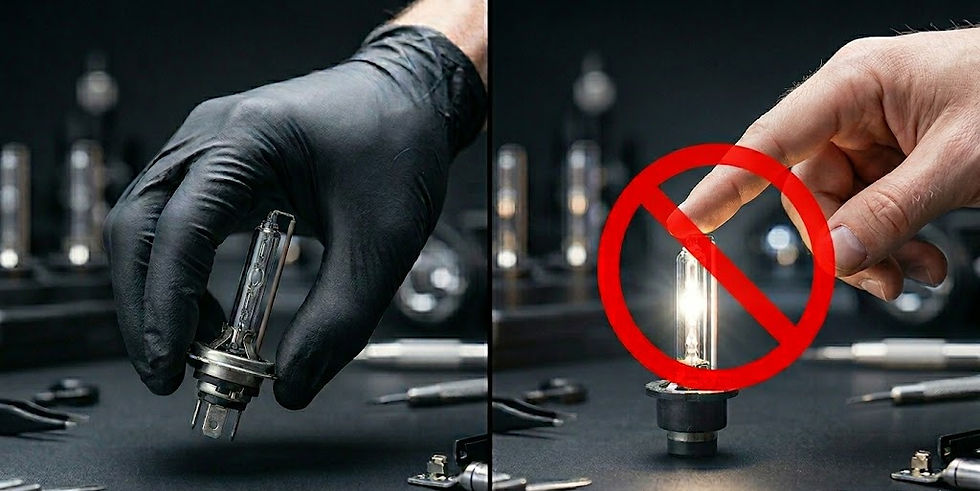
You've just bought a new xenon kit, you're ready to install it, and someone tells you not to touch the bulb with your bare hands. Maybe it's on the packaging, maybe a mate mentioned it, maybe you read it somewhere online. It sounds like an overly fussy instruction, after all, it's a light bulb, not a surgical instrument. How much damage could a fingerprint possibly do?
As it turns out, quite a lot. The reason why can't you touch HID bulbs with bare skin is rooted in straightforward physics and chemistry , and once you understand it, the instruction makes complete sense. It's not about being delicate for its own sake. It's about the fact that these particular components operate under conditions that make contamination genuinely destructive, in ways that can shorten the life of an expensive component or cause it to fail suddenly.
This guide explains exactly why, what types of contamination cause the most damage, how to handle bulbs correctly, and what to do if you've already touched one.
The Science Behind It, Why Can't You Touch HID Bulbs?
What Skin Oil Actually Does to Quartz Glass
Human skin is never truly clean. Even immediately after washing, your skin continues to produce sebum , the natural oil your body secretes to keep skin flexible and protected. This oil is invisible in small quantities, but it transfers from skin to whatever you touch with remarkable efficiency. Even the lightest, briefest contact with a glass surface leaves a detectable film.
The issue is what happens to that oil when the bulb operates. A xenon bulb generates intense light by passing a high-voltage arc through a tube of xenon gas. The quartz glass tube enclosing this arc reaches temperatures of 800 to 900 degrees Celsius at the surface , far beyond what any organic compound can survive. When the oil from your fingerprint is present on the surface, it doesn't just burn off cleanly. It bakes into the quartz, leaving a carbon residue that absorbs heat differently from the surrounding clean glass.
This difference in heat absorption is the core problem. The clean quartz around a fingerprint transmits heat evenly and manages thermal expansion uniformly. The contaminated area absorbs more heat, expands slightly faster and more, and creates localised thermal stress at the boundary between clean and contaminated glass. Over repeated heating and cooling cycles, this stress can cause the quartz to develop micro-fractures , invisible at first, but progressive. The result is either a bulb that develops a visible crack and fails suddenly, or one that loses efficiency progressively as the contamination degrades optical clarity and causes increasingly uneven heating.
Why HID Bulbs Are More Vulnerable Than Regular Glass
You might wonder why the same rule doesn't apply to LED bulbs, or why touching a standard glass bottle doesn't cause it to crack. The answer is the material: xenon bulbs are made from quartz, not ordinary glass. And quartz behaves very differently from regular glass under thermal stress.
Ordinary glass has relatively high thermal expansion , it expands significantly when heated and contracts significantly when cooled. Quartz has extremely low thermal expansion , it can handle rapid, extreme temperature changes without cracking precisely because it doesn't expand much. This is why quartz is used in applications that require resistance to thermal shock.
The catch is that quartz's low expansion tolerance works perfectly when the temperature is uniform across the surface. When one spot on the quartz surface is absorbing more heat than the surrounding area , which is exactly what happens when skin oil creates a hot spot , the thermal expansion at that point exceeds the quartz's ability to accommodate it. The result is stress cracking, starting at the hot spot boundary. It's the same material property that makes quartz perfect for high-temperature applications that makes it vulnerable to the very localised heating created by contamination.
Science Why Washing Your Hands Is Not Enough Your skin produces sebum continuously. Even soap-washed hands begin secreting oil within minutes. The thin film this creates is invisible to the naked eye but fully capable of contaminating a bulb surface. This is why gloves rather than handwashing are the correct solution. A fresh pair of nitrile or latex gloves provides a genuine barrier that recently-washed bare skin cannot. |
The Halogen Cycle and Why It Matters Here
To understand why contamination affects xenon bulbs specifically, it helps to understand the tungsten-halogen cycle that keeps these bulbs functioning. Inside the sealed xenon tube, two tungsten electrodes slowly erode as they generate the electrical arc. The xenon gas and halide compounds in the tube re-deposit evaporated tungsten back onto the electrodes , a self-cleaning cycle that maintains arc quality and extends bulb life.
This cycle only functions correctly within a specific temperature range , which requires the quartz surface to be completely clean and uniform. When contamination disrupts the surface temperature uniformity, it interferes with the cycle, causing the tungsten re-deposition to occur unevenly. The result is electrodes that wear inconsistently, with some areas eroding faster than designed, which shortens the bulb's operational lifespan. The contamination doesn't just damage the glass , it disrupts the internal chemistry that keeps the bulb functioning correctly
What Contaminants Cause the Most Damage
Skin oil is the most common contamination source, but it's not the only one. In Australian conditions , where outdoor work in the heat is common and a wide range of products are regularly applied to hands , there are several specific contaminants that drivers need to be aware of:
Contaminant | How Common | How It Damages | Australian Context |
Skin oils (sebum) | Most common , always present on skin | Creates hot spot on quartz glass , causes thermal stress and cracking | Transferred by any skin contact , even a quick touch |
Sweat and salt deposits | Present whenever skin is warm | Salts etch and weaken the quartz structure , creates fracture points | Accelerated in Australian summer heat when working underbonnet |
Sunscreen | Extremely common in Australia , most people have it on hands | Dense chemical compound burns aggressively at operating temperature | Often forgotten , sunscreen is oil-based and highly damaging |
Hand lotion or moisturiser | Very common , especially in dry climates | Wax and oil-based compounds cause severe hot spotting | Stays on skin even after rinsing. Always check hands. |
Insect repellent (DEET-based) | Common in Australian outdoors context | DEET and carrier compounds are petroleum-based , very damaging | Particularly relevant for 4WD owners and rural Australians |
Cooking oils or food residue | Realistic , changing bulbs after dinner or cooking | Highly refined oils burn rapidly and intensely at HID temperatures | Wipe hands thoroughly before any bulb handling |
Workshop grease or lubricant | Common in garage or workshop environment | Heavy petroleum compounds cause extreme hot spotting , very high damage risk | Use fresh nitrile gloves after any workshop work |
Dust and fine grit | Airborne in Australian outback , settles on everything | Abrasive particles can scratch quartz and trap oils underneath | Wipe bulb with clean isopropyl cloth after handling even with gloves |
* All contaminants listed cause damage when a bulb is operated after contamination. Damage is largely preventable by correct handling. Clean contamination with 70%+ isopropyl alcohol on a lint-free cloth if accidental contact occurs.
The sunscreen entry in that table deserves specific attention for Australian drivers. Australia has the highest melanoma rate in the world, and most Australians apply sunscreen to their hands as a matter of course. If you've applied sunscreen in the last several hours, your hands are contaminated for bulb handling purposes even if you've washed them since. Sunscreen is formulated to resist washing off and to bond with skin , exactly the properties that make it persistent and damaging when transferred to a quartz surface. This is not a theoretical risk: it's one of the more common causes of premature xenon bulb failure in Australian vehicles, and it's one that most drivers don't connect to the bulb failure they experience weeks later
How to Handle Bulbs Correctly
The correct handling approach is not complicated, but it does require deliberate preparation rather than just grabbing the bulb and hoping for the best. Here is the full guide:
Handling Method | Effectiveness | How It Works | Practical Notes |
Nitrile or latex gloves | Best option , widely available | Full hand protection from all skin oils and contaminants | Available at Repco, Supercheap, Bunnings. Keep a box in the garage. |
Clean cotton cloth or tissue | Good option , often more practical | Provides barrier without gloves , effective for most handling | Must be genuinely clean and lint-free. Don't use a workshop rag. |
Paper towel | Acceptable emergency option | Dry paper provides adequate barrier for brief, careful handling | Better than bare hands , but less reliable than gloves or cloth |
Bubble wrap or original packaging | Excellent , bulb is ready to install | Lets you handle bulb directly through the packaging material | Many quality bulbs are individually wrapped. Use this until the moment of installation. |
Bare hands (accidental touch) | Should be avoided , but recoverable | Isopropyl alcohol wipe immediately after contact can recover the bulb | Clean with 70%+ IPA on a lint-free cloth before switching on |
Bare hands (no clean-up) | Do not do this | Hot spot forms on first use, lifespan dramatically shortened | Contaminants bake onto the quartz at operating temperature , not reversible |
* Isopropyl alcohol (IPA) at 70% or higher is the recommended cleaning agent for contaminated bulbs. Available at pharmacies, Bunnings, and automotive stores. Use a lint-free cloth or lens tissue , not paper towel, which can leave fibres.
What to Do If You've Already Touched the Bulb
If you've realised mid-installation that you've touched the glass with bare hands, don't panic , and definitely don't switch the bulb on before addressing it. Contamination is only damaging once the bulb reaches operating temperature and the oil bakes into the quartz. Before first use, the contamination can be removed.
The Isopropyl Alcohol Clean
The standard recovery process is straightforward:
* Get isopropyl alcohol at 70% concentration or higher , available from pharmacies, Bunnings, Repco, and Supercheap Auto. Medical-grade 99% IPA is ideal but pharmacy-grade 70% works well.
* Use a lint-free cloth or lens tissue , not paper towel (which can leave fibres), not a garage rag (which will add more contamination), and not a dry tissue (which will just smear the oil).
* Wipe gently from one end of the glass tube to the other in a single direction. Don't scrub back and forth, which can redistribute oil.
* Let the IPA evaporate completely , it dries quickly, usually within 30 seconds in normal Australian conditions. The surface should look completely clear and matte when dry.
* Check the surface under a light at an angle before installation. A clean quartz surface will show no fingerprint marks, smearing, or haze. A still-contaminated surface will show clearly under angled light.
Done correctly, an IPA clean fully recovers a contaminated bulb before it's been used. The oil has not been baked on yet , it's simply sitting on the surface and is fully soluble in isopropyl alcohol. This is one of the reasons xenon kits from reputable suppliers often include an IPA wipe , it's a recognised part of the installation process, not an afterthought
What If the Bulb Has Already Been Used After Being Touched?
If you touched the bulb and then switched it on before realising, the situation is less recoverable. The heat from the first use bakes the oil into the quartz surface, creating a carbon residue that is no longer soluble in IPA. You can clean the surface and remove the remaining oil, but the already-baked carbon residue cannot be removed without risking damage to the quartz itself.
The practical question at this point is how significant the contamination was. A very light, brief fingertip touch may have transferred enough oil to cause a hot spot eventually, but the damage may take some time to manifest and the bulb may still last a reasonable period. A full hand grip or contact with a heavily-contaminated hand (sunscreen, lotion, grease) can cause visible damage on the first use or very shortly after.
If you notice uneven brightness, colour variation across the beam, or any visible mark or discolouration on the glass tube after first use , these are signs that contamination has caused early thermal damage. At this point, replacing the bulb is the pragmatic decision. Continuing to use a contaminated bulb risks sudden failure , potentially at night on a country road , and the additional heat stress can in some cases damage the headlight housing as the compromised quartz fails to manage heat uniformly
Warning Never Switch On a Bulb You Know Was Contaminated If you've touched the glass and haven't cleaned it yet, do not switch the headlights on. The damage window is short , a single heat cycle bakes the contamination on permanently. Clean it first with IPA on a lint-free cloth, let it dry completely, then proceed with installation. This is the one step that separates a recoverable situation from an unrecoverable one. |
The Electrical Safety Dimension
Beyond the thermal damage risk, there is a second reason to handle xenon bulbs with care: electrical safety during installation
These systems operate at high voltage , the ballast generates a pulse of up to 25,000 volts to strike the initial arc in a cold xenon bulb, then settles to around 85 volts during normal operation. This is far beyond what the standard 12V vehicle electrical system produces anywhere else in the car. While the stored charge dissipates quickly after the headlights are switched off, there is a brief period after switch-off where dangerous voltage may still be present in the circuit.
For installation purposes, always disconnect the vehicle's battery or at minimum the headlight fuse before handling the ballast, wiring, or any live component of the HID system. Modern systems have protective circuits that reduce residual voltage rapidly, but waiting 30 seconds after switching off before touching any component of the system is a sensible practice that costs nothing and eliminates the risk
When handling the bulb itself during installation, the glass tube is not live , the dangerous voltages are in the igniter cable and ballast, not the glass envelope. But the connections at the base of the bulb should be treated as potentially live whenever the system has recently been powered.
Australian Conditions and Why They Make This More Relevant
The warning about not touching xenon bulbs applies everywhere, but there are specific aspects of Australian conditions that make it more relevant for Aussie drivers:
High ambient temperature: Working on a car in Australian summer , particularly in Queensland, the NT, and WA where underbonnet temperatures can push well above ambient , means the bulb housing may already be warm when you're handling it. A warm surface accelerates the baking of any contamination on first contact, reducing the window between contamination and heat-set damage
Sunscreen culture: As noted above, Australians apply sunscreen to their hands far more consistently than people in most other markets. This is a genuinely common source of contamination that is underappreciated in most guides written for overseas audiences. If you're working outdoors in Australia and you've applied sunscreen , even earlier that day , gloves are not optional. They're essential
Outdoor and rural bulb changes: A flat and remote scenario , or even just changing a bulb in a rural driveway , creates conditions where dust, grit, and airborne contamination are more prevalent than in a controlled garage environment. In red-earth outback conditions, fine dust settles on every surface almost immediately. Even a gloved hand that brushed a dusty surface before handling the bulb can transfer abrasive particles. Inspect the gloves before handling
4WD and off-road use: Vehicles used off-road are more likely to need bulb attention in the field , on a dirt track, at a campsite, or during a remote crossing. In these conditions, the combination of grime, dust, insect repellent, and limited clean water for hand-washing creates exactly the conditions where careful bulb handling is hardest and most important. A zip-lock bag of fresh gloves and a small bottle of IPA kept in the glovebox is a practical preparation for any off-road Australian driver running xenon lights
The Complete Safe Handling Checklist for Xenon Bulbs -> Always use fresh nitrile or latex gloves , the single most effective protection available -> Check your hands for sunscreen, lotion, insect repellent, or any other product before reaching for gloves -> Keep the bulb in its original packaging until the moment of installation -> Handle by the base only , never touch the glass tube, even with gloves (lint from gloves can trap oils) -> If accidental contact occurs , clean immediately with 70%+ IPA on a lint-free cloth before switching on -> Inspect the cleaned surface under angled light , it should be completely clear and show no marks or haze -> In Australian summer heat, work in the shade or in the cool of the morning , warm conditions accelerate contamination effects -> For outback and 4WD preparedness: keep a zip-lock bag of fresh gloves and a small IPA bottle in your vehicle -> Disconnect battery or headlight fuse before working on any component of the HID electrical system -> If the bulb has been used while contaminated , replace it, don't risk sudden failure at night on a remote road |
Does the Same Rule Apply to Halogen and LED Bulbs?
Yes for halogen, no for LED , and the reason explains why:
Halogen bulbs: The same rule applies and for essentially the same reasons. Halogen bulbs also use quartz glass (not ordinary glass) and operate at very high temperatures where skin oil contamination creates identical hot spot problems. The surface temperature of a halogen bulb is slightly lower than a xenon bulb , typically 250 to 300 degrees Celsius at the glass surface versus 800 to 900 for xenon , but high enough that contamination absolutely causes thermal stress and shortened lifespan. Do not touch halogen bulbs with bare skin either
LED bulbs: LED bulbs do not have this problem. LEDs produce light through electroluminescence , a semiconductor process that generates very little heat at the light-emitting surface. The light source is a chip, not a glass tube, and the outer housing is usually polycarbonate plastic rather than quartz. Skin oils on a plastic LED housing do not create meaningful thermal stress because the housing doesn't reach temperatures high enough to bake the oil. LED bulbs can be handled normally with bare hands without concern
This is one of the practical handling advantages of LED over xenon , not just for daily use but for installation and maintenance. An LED kit can be picked up, installed, and adjusted without the same level of care. For fleet managers, workshop staff, or anyone who regularly changes car lighting, LED's forgiving handling requirements are a genuine operational benefit
Frequently Asked Questions
I accidentally touched my new xenon bulb. Is it ruined?Not necessarily, and how you respond in the next few minutes determines the outcome. If the bulb has not yet been switched on, the contamination is still sitting on the surface and can be fully removed. Get isopropyl alcohol at 70% or higher (pharmacy-grade IPA or automotive contact cleaner with high IPA content) and a genuinely clean, lint-free cloth or lens cleaning tissue. Wipe the glass surface gently in one direction from one end to the other, let the IPA evaporate completely (usually 30-60 seconds in Australian ambient temperature), then inspect the surface under a light at an angle. A clean surface shows no marks or haze. Repeat the clean if any contamination is still visible. A properly cleaned contaminated bulb is fully recoverable before first use. If the bulb has already been switched on after being touched, the situation is harder to assess. A brief, light touch may have caused limited damage that takes time to manifest. A significant hand contact or contact with a heavily contaminated hand (sunscreen, lotion, grease) may have caused immediate structural stress. If the bulb is producing uneven light, showing colour variation, or has any visible mark on the glass after use, replacement is the practical decision. |
Can I use a regular glass cleaner to clean a contaminated bulb?No , and using the wrong cleaning product can make things worse. Regular window or glass cleaners contain surfactants, ammonia, and other compounds that are designed for ordinary glass, not quartz. These compounds can leave a residue that is itself damaging at high operating temperatures, essentially trading one contamination problem for another. The correct cleaning agent is pure isopropyl alcohol (IPA) at 70% concentration or higher. This dissolves skin oils and most organic contaminants cleanly without leaving any residue after evaporation. It's the same product used to clean optical glass, camera lenses, and precision optics , all of which have the same sensitivity to residue as automotive xenon bulbs. Pharmacy-grade IPA (available in small bottles for around $5-8 AUD), specialist optical cleaning alcohol, or automotive electrical contact cleaner with high IPA content are all appropriate choices. Methylated spirits is a reasonable alternative if IPA is unavailable, though it can leave a slight residue in some formulations. After any cleaning, allow the surface to dry completely before switching on. |
My headlights are flickering or one side is dimmer after a recent bulb change. Could touching the bulb have caused this?It's possible, though flickering and uneven brightness have several potential causes. If a bulb was touched during installation and not cleaned before first use, contamination-related thermal damage can cause the quartz to develop micro-fractures that create visible hot spots or uneven light output , and in some cases, the early-stage cracking around a hot spot disrupts the arc stability inside the bulb, causing flicker. Other causes of the same symptoms include a failing ballast (particularly if the flickering is on the same side as the recently changed bulb), a CANBUS compatibility issue (which typically causes regular intermittent flickering rather than steady dimness), or a bulb that was damaged during installation. To diagnose: if the problem is on the side of the recently changed bulb, swap the bulb to the other side and see if the problem follows the bulb. If it does, the bulb is the fault. If the problem stays on the same side regardless of which bulb is in it, the ballast or wiring is the fault. If you can see any visible mark, discolouration, or irregular glow on the glass tube of the bulb in question, that confirms contamination damage and the bulb should be replaced. |
The Bottom Line
The rule about not touching xenon bulbs with bare hands is not overcautious advice , it is based on straightforward physics. Skin oils on a surface that reaches 800-900 degrees Celsius don't just burn off , they create localised thermal stress in a quartz material that's extremely sensitive to uneven heating. The result is either a bulb that develops micro-fractures and fails early, or one that disrupts the internal tungsten-halogen cycle and loses efficiency progressively.
In Australian conditions , where sunscreen, insect repellent, and hot ambient temperatures combine to create a more demanding contamination environment than most guides assume , gloves are the correct standard practice, not an optional precaution. A box of nitrile gloves costs a few dollars and lasts for dozens of installations. A xenon bulb costs $30 to $80 and lasts years when handled correctly, or months when it isn't
And if you've already touched one: clean it with IPA on a lint-free cloth before switching on, and the situation is fully recoverable. The two-minute clean is always worth doing , it's the difference between a bulb that performs as expected for years, and one that fails unpredictably on a dark road somewhere between here and wherever you're going


Comments